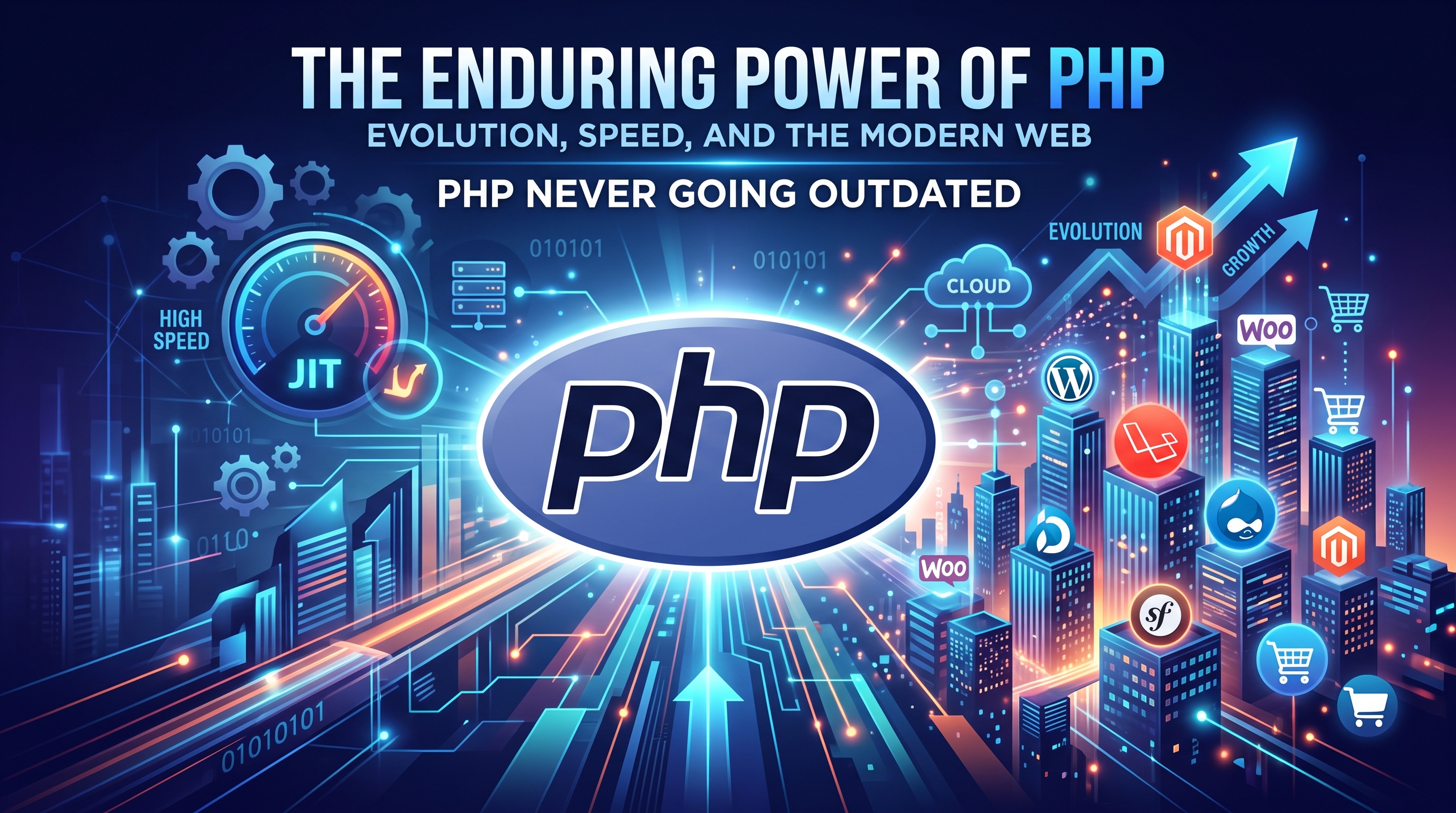
PHP is often unfairly labeled as a relic of the early web, but the numbers—and the codebase powering the internet—tell a completely different story. It isn't just surviving; it is actively shaping modern web development.
The Unshakable Foundation: Powering Most of the Web
Despite frequent predictions of its demise, PHP quietly runs over 75% of all websites with a known server-side programming language.
The CMS Monopolies: Platforms like WordPress, Drupal, and Joomla run on PHP. WordPress alone powers over 40% of the entire web, from personal blogs to enterprise media outlets.
E-Commerce Heavyweights: WooCommerce and Magento drive a massive chunk of global digital storefronts. As long as businesses rely on these ecosystems, PHP remains irreplaceable.
Modern Evolution: PHP 8.x is Not Your 2005 PHP
If your memory of PHP is spaghetti code from the early days, modern PHP will surprise you. Recent iterations have introduced features that align it directly with modern enterprise languages:
Just-In-Time (JIT) Compilation: Dramatically improves execution speed for heavy computation tasks.
Strict Typing & Attributes: Adds robust static analysis capabilities, making code cleaner, safer, and easier to maintain.
Constructor Property Promotion & Match Expressions: Reduces boilerplate code significantly for faster development cycles.
The Powerhouse Ecosystem: Laravel and Beyond
Modern PHP web development relies heavily on Laravel, which has set a high standard for developer experience across the industry.
Cost-Efficiency and Deployment Simplicity
While newer stacks often require complex build pipelines, container setups, and expensive infrastructure, PHP remains unmatched in deployment speed and hosting costs:
Ubiquitous Hosting: Virtually every web host natively supports PHP out of the box at minimal cost.
Low Time-to-Market: Full-featured web applications, APIs, and SaaS tools can be bootstrapped, built, and launched rapidly without bloated overhead.
Languages don't die because a new trend emerges; they fade when they stop evolving or lose utility. With continuous performance upgrades, an active global community, and an irreplaceable footprint, PHP continues to prove its permanence. It isn't going outdated—it's simply getting better.
The Unshakable Foundation: Powering Most of the Web
Despite frequent predictions of its demise, PHP quietly runs over 75% of all websites with a known server-side programming language.
The CMS Monopolies: Platforms like WordPress, Drupal, and Joomla run on PHP. WordPress alone powers over 40% of the entire web, from personal blogs to enterprise media outlets.
E-Commerce Heavyweights: WooCommerce and Magento drive a massive chunk of global digital storefronts. As long as businesses rely on these ecosystems, PHP remains irreplaceable.
Modern Evolution: PHP 8.x is Not Your 2005 PHP
If your memory of PHP is spaghetti code from the early days, modern PHP will surprise you. Recent iterations have introduced features that align it directly with modern enterprise languages:
Just-In-Time (JIT) Compilation: Dramatically improves execution speed for heavy computation tasks.
Strict Typing & Attributes: Adds robust static analysis capabilities, making code cleaner, safer, and easier to maintain.
Constructor Property Promotion & Match Expressions: Reduces boilerplate code significantly for faster development cycles.
The Powerhouse Ecosystem: Laravel and Beyond
Modern PHP web development relies heavily on Laravel, which has set a high standard for developer experience across the industry.
Cost-Efficiency and Deployment Simplicity
While newer stacks often require complex build pipelines, container setups, and expensive infrastructure, PHP remains unmatched in deployment speed and hosting costs:
Ubiquitous Hosting: Virtually every web host natively supports PHP out of the box at minimal cost.
Low Time-to-Market: Full-featured web applications, APIs, and SaaS tools can be bootstrapped, built, and launched rapidly without bloated overhead.
Languages don't die because a new trend emerges; they fade when they stop evolving or lose utility. With continuous performance upgrades, an active global community, and an irreplaceable footprint, PHP continues to prove its permanence. It isn't going outdated—it's simply getting better.